What is the PPWR?
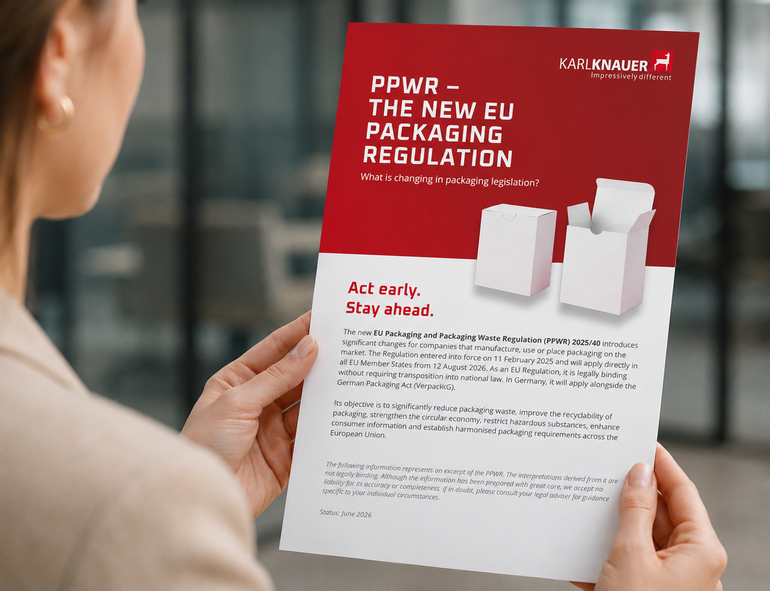
The Packaging and Packaging Waste Regulation (PPWR) establishes a harmonised legal framework for packaging and packaging waste across the European Union. Its aim is to reduce packaging waste, strengthen the circular economy and improve the recyclability of packaging.
The new requirements affect virtually all businesses that place packaging on the market – from brand owners and manufacturers to retailers.
Roles and Responsibilities under the PPWR
The PPWR defines a number of roles within the packaging supply chain. The obligations a business must fulfil depend on the role it assumes within its particular business model. A company may also hold several roles simultaneously.
Manufacturer
The manufacturer is responsible for the design or production of packaging and for ensuring that it complies with the applicable PPWR requirements. This includes, among other things, carrying out the conformity assessment and preparing the technical documentation.
Supplier
Suppliers provide packaging or packaging components to other businesses within the supply chain. They support their customers with suitable packaging solutions and provide the information required for their further use.
Importer
Importers place packaging or packaged products from non-EU countries on the European market for the first time. They are responsible for ensuring that these products comply with the requirements of the PPWR.
Distributor
Distributors make packaging or packaged products available within the supply chain without manufacturing or importing them themselves. They are also responsible for ensuring that only compliant products are supplied further along the chain.
What role does Karl Knauer play?
Karl Knauer develops and manufactures high-quality packaging solutions for a wide range of industries. Depending on the customer project and the structure of the supply chain, we act as a supplier as defined by the PPWR.
From the earliest stages of packaging development, we take into account factors such as material efficiency, Design for Recycling and future PPWR requirements, helping our customers develop sustainable, future-ready packaging solutions.
What does the PPWR mean for businesses?
- Recyclability
In future, packaging will need to meet defined European recyclability criteria. As a result, material selection, structural design and the interaction of all packaging components will become increasingly important from the earliest stages of development. - Packaging Reduction
The PPWR requires packaging to use materials as efficiently as possible. Packaging must continue to provide effective product protection and marketing performance while avoiding unnecessary material use and empty space. - Documentation Requirements
Businesses will be required to provide more comprehensive information demonstrating the compliance of their packaging. As a result, the traceability of materials and packaging characteristics will become increasingly important. - Design for Recycling
Recyclability is determined during the packaging development process. Material combinations, finishes, adhesives and structural designs should be selected to support existing recycling processes as effectively as possible. - Competitiveness
The PPWR is not only a regulatory challenge but also an opportunity. Companies that adapt their packaging at an early stage can use resources more efficiently, support their sustainability objectives and prepare for future market requirements.
How the changes affect your packaging
Depending on the packaging concept, the following aspects, among others, can be assessed:
- Material usage and packaging weight
- Material combinations and composite structures
- Structural design and Design for Recycling
- Packaging recyclability
- Finishes, coatings and adhesives
- Documentation requirements
- Resource efficiency throughout the entire value chain


“PPWR compliance is not something that is achieved at the end of a project. It begins with the development of packaging concepts, material selection and Design for Recycling. The requirements set out in the Regulation have been an integral part of our consulting approach for many years – and that is precisely where we support our customers.”
Christoph Eisenmann,
Product Development, Karl Knauer KG
How Karl Knauer Supports Businesses

The requirements of the PPWR do not begin with the assessment of a finished package – they start during the development process. That is why Karl Knauer supports its customers from the initial concept through to production-ready packaging, taking into account regulatory requirements as well as technical, commercial and brand-specific considerations.
Packaging Analysis
We assess existing packaging solutions in terms of material usage, structural design, recyclability and optimisation potential. This enables opportunities for improvement to be identified at an early stage.
Development of New Packaging Solutions
Our packaging development team creates bespoke solutions that balance product protection, brand impact, resource efficiency and future PPWR requirements.
Design for Recycling
From the very beginning, we consider established recycling processes when selecting materials and developing packaging structures. Our goal is to create packaging that can be integrated as efficiently as possible into existing recycling streams.
Material and Structural Optimisation
We develop packaging solutions that use materials efficiently without compromising stability, functionality or product protection.
End-to-End Production
As both a packaging developer and manufacturer, we manage the entire process – from the initial concept and prototyping through sampling to industrial-scale production. This ensures packaging solutions that are both technically sophisticated and commercially viable. We are also happy to provide co-packing and direct-to-consumer fulfilment services for your products.

PPWR FAQ: Answers to Your Questions About the New EU Packaging Regulation
What does PPWR stand for?
PPWR stands for Packaging and Packaging Waste Regulation. It is the new EU Regulation designed to make packaging more sustainable, reduce packaging waste and strengthen the circular economy across Europe.
What is the difference between the PPWR and the previous Packaging Directive?
The previous Packaging Directive had to be transposed into national law by each EU Member State. The PPWR is an EU Regulation and therefore applies directly across all Member States. Its purpose is to establish harmonised packaging requirements throughout the European Union.
When does the PPWR apply?
The PPWR entered into force in 2025. Most of its requirements will become applicable from August 2026, with additional provisions being introduced gradually until 2030 and beyond.
Which businesses are affected by the PPWR?
The Regulation applies to all businesses that place packaging or packaged products on the European market. This includes manufacturers, brand owners, distributors, importers and online retailers.
Which types of packaging are covered by the PPWR?
The PPWR applies to virtually all types of packaging, regardless of the material used. This includes packaging made from paper, cardboard, plastic, glass, metal and composite materials.
What are the objectives of the PPWR?
The European Union aims to:
- Reduce packaging waste
- Promote reuse
- Improve recyclability
- Increase the use of recycled content
- Conserve natural resources
- Harmonise packaging requirements across the EU
What does "recyclable" mean under the PPWR?
Packaging should be designed so that it can be effectively collected, sorted and recycled within existing waste management systems. Compliance will be assessed according to harmonised European criteria.
What is Design for Recycling?
Design for Recycling refers to the development of packaging with the aim of improving its recyclability. Material selection, structural design, printing, finishes and the ease of separating individual components all play an important role.
What requirements does the PPWR place on paper and cardboard packaging?
Paper and cardboard packaging must also support circularity and recyclability. Particular emphasis is placed on material-efficient designs and on considering established recycling processes from the earliest stages of packaging development.
How will the PPWR affect packaging design and development?
The Regulation increases the importance of a holistic approach to packaging development. In addition to product protection and brand presentation, companies must also consider recyclability, material efficiency, documentation and regulatory compliance.
Will packaging have to contain less material?
The PPWR introduces requirements aimed at minimising packaging. Packaging should use no more material than necessary while maintaining product protection and safety.
Will certain types of packaging be banned?
For selected applications, the Regulation introduces restrictions or prohibitions on certain packaging formats. The objective is to reduce avoidable packaging waste and encourage more resource-efficient solutions.
Are there new labelling requirements?
Yes. The PPWR introduces harmonised labelling systems designed to help consumers correctly separate and dispose of packaging.
Are there new labelling requirements?
Under the PPWR, pallet tags may no longer be supplied without identifying the responsible producer. If you wish to use your own producer identification, please let us know in good time. Unless instructed otherwise, we will include the required producer information on your pallet tags.
What role will QR codes and digital product information play?
Digital information solutions are expected to become increasingly important. They can provide additional information on material composition, recycling and disposal, while improving transparency throughout the value chain.
Will reusable packaging become mandatory?
The Regulation introduces specific requirements and targets for reuse and reusable packaging in certain applications. The exact obligations depend on the market sector and the type of packaging involved.
How will the PPWR affect brand owners?
Brand owners should review their packaging at an early stage to assess future compliance requirements. Changes may be required to materials, structural design, labelling or documentation.
How can businesses prepare for the PPWR?
Recommended steps include:
- Reviewing existing packaging
- Assessing recyclability
- Optimising material structures
- Reviewing packaging dimensions
- Preparing for future labelling requirements
- Establishing the necessary regulatory documentation
Why is it important to prepare for the PPWR now?
Packaging development and material changes often require long lead times. Companies that begin preparing early can plan necessary adjustments more efficiently and be better positioned to meet future regulatory requirements.
How does Karl Knauer support businesses with the PPWR?
Karl Knauer helps businesses develop future-ready packaging solutions. Our experts analyse existing packaging concepts, identify opportunities for optimisation and develop solutions with a focus on recyclability, resource efficiency and future regulatory requirements.
Do you have questions about the PPWR?
Would you like to understand how the new EU Packaging and Packaging Waste Regulation will affect your packaging? Get in touch with the packaging experts at Karl Knauer. Together, we will assess your requirements and develop tailored solutions for sustainable, future-ready packaging.
![[Translate to English:]](/fileadmin/_processed_/e/8/csm_20221209_Karl_Knauer_Gabelstapler_01_c25636d1ce.jpg "[Translate to English:]")